
Kitchen planning
Quartz, Granite and Other Kitchen Countertop Choices
Quartz and granite are both durable, high-end kitchen countertops, and the better choice depends on how you cook and what care you will accept. Engineered quartz is consistent in color and, for brands such as Cambria, never needs sealing, but it needs protection from direct heat. Granite is natural stone that tolerates heat better and resists scratching, though each slab is unique and some benefit from sealing. Laminate and solid surface cost less and suit many kitchens. Whatever you choose, compare the full installed scope, not only the material.
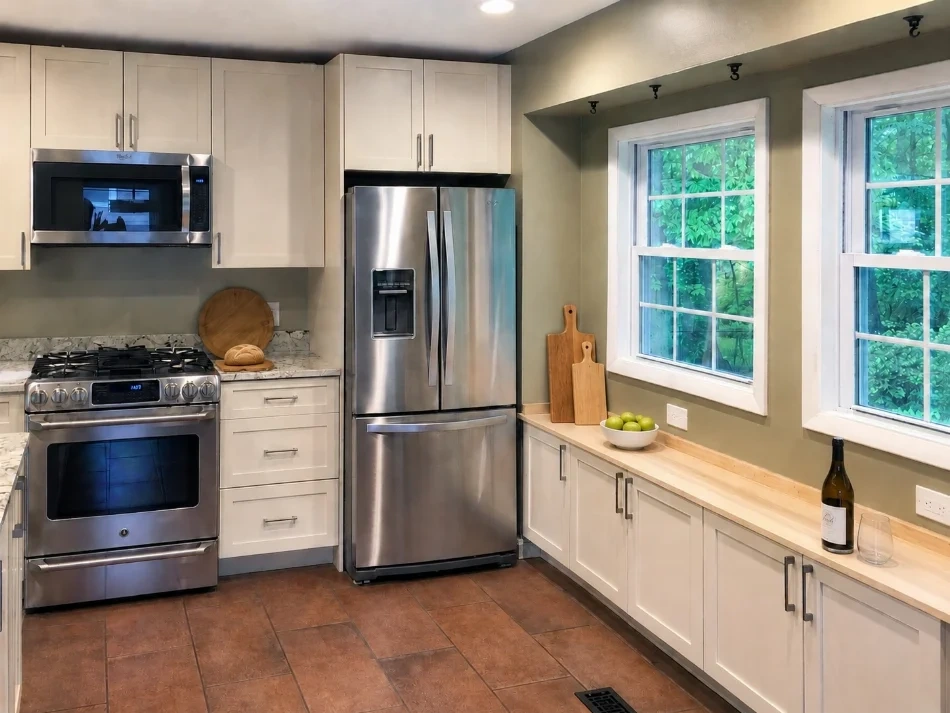
Begin with use, appearance and the installed scope
Start with how the kitchen is used. Do you cook often with heavy pans, use countertop appliances that run hot, chop directly on the surface, or leave spills until later? Do you want a uniform color or the movement of natural stone? How do you feel about periodic care? Answering those questions narrows the choice faster than browsing samples.
Then look at real material. A small sample shows color and texture, but natural stone varies from slab to slab and even across one slab, and engineered products vary between brands and finishes. For stone, approve the actual slab when you can. Finally, remember that a countertop proposal covers more than the material: thickness, edge profile, sink and cooktop cutouts, backsplash, seams and installation all belong in the comparison.
Quartz versus granite at a glance
This summary reflects the cited care guidance for the named examples. Treat brand statements as specific to that brand, and always follow the care sheet for the exact product you buy.
| Material and example | What it is | Documented care point | Heat and impact precaution |
|---|---|---|---|
| Engineered quartz (Cambria) | Quartz particles bound with resin, made in slabs | Cambria says its quartz never needs sealing or polishing | Use a hot pad or trivet; use a cutting board |
| Granite (natural stone) | Natural igneous stone cut from quarried blocks | Most granite does not need sealing; some benefits from it | Tolerates heat well, but avoid direct localized heat |
| Solid surface | Nonporous manufactured sheet material | Follow the manufacturer's care and repair guidance | Protect from hot cookware |
| Laminate (Formica) | Decorative layer bonded to a wood-based core | Clean gently; do not flood seams | Protect from heat and cutting |
Quartz: follow the selected manufacturer's care limits
Engineered quartz is made from crushed quartz bound with resins and pigments, so its color and pattern are consistent and it does not need the sealing natural stone sometimes does. Cambria, one of the best-known brands, says its quartz is stain resistant and never requires sealing, polishing or reconditioning, and recommends warm water, a soft cloth and mild soap for routine cleaning.
Quartz is not heatproof or scratchproof. Cambria warns that its product may not withstand direct heat transfer from pots, pans and cooking appliances such as electric griddles, slow cookers and roaster ovens, especially with sudden temperature changes near the edges, and recommends a closed-weave hot pad or a solid trivet every time. It also recommends always using a cutting board, since cutting can leave marks on more uniform designs. So, can you put hot pans on quartz? Not directly; use a trivet. Other brands publish their own care terms and warranties, so ask for the care sheet of the product you are quoted.
Source: Cambria: Quartz product care
Granite: skip the automatic sealing and heat assumptions
A common rule of thumb says granite must be sealed every year. The Natural Stone Institute disagrees: its position on sealing says most granite countertops do not need to be sealed, and that a homeowner who cleans after each meal will rarely have staining or cleanability problems. It also says many granite countertops do benefit from sealing, which further reduces moisture migration into an already moisture-resistant surface. The right answer depends on the specific stone and any factory treatment, so ask your fabricator for a written care recommendation for the slab you buy.
Granite handles heat and scratches well. The Natural Stone Institute notes that most granites are harder than the utensils used on them and are typically heat resistant to about 480 degrees Fahrenheit, but it discourages direct, localized heat sources because strong temperature differences within the stone can start a crack. Trivets are still a good habit.
Source: Natural Stone Institute: Statement of position on sealing natural stone countertops
Source: Natural Stone Institute: Granite
Quartz versus quartzite
The names sound alike but describe different materials. Quartz countertops are engineered products made in a factory. Quartzite is a natural stone, a metamorphic rock formed from quartz-rich sandstone, quarried and cut into slabs like granite. It can offer a marble-like look with greater hardness, but natural stones are sold under many trade names, and the care needs of a slab depend on its actual composition.
If you are drawn to quartzite, approve the actual slab, ask the fabricator how that stone has performed in kitchens, and get a written care recommendation, including whether sealing is advised.
Solid surface and laminate as practical options
Solid surface countertops are manufactured sheets that can be joined with inconspicuous seams and formed into integrated sinks. They are generally more sensitive to heat and cuts than stone, and minor surface damage can often be repaired. Corian is the best-known brand; follow the care and repair guidance for the specific product you choose, and note that Corian also sells a separate quartz line with different care terms.
Laminate offers the widest range of colors and patterns at a lower cost. Its main vulnerabilities are heat, cuts and water reaching the core. Formica's care guidance recommends cleaning with a damp, nonabrasive cloth and mild detergent, and warns not to flood the laminate, especially near seams, because water can penetrate and cause the substrate to swell. A well-installed laminate top with sealed edges and a carefully placed seam can serve a kitchen well for years.
Resolve seams, edges, sink openings and support
Seams are where countertop expectations most often go wrong. Slabs and sheets come in limited sizes, so long runs, L-shapes and islands may need joints. Ask the fabricator to show the seam locations on a layout drawing before you approve it, along with the pattern direction for stone or veined quartz. Do not assume a seamless result unless the drawing shows one.
Coordinate the details at the same time: the edge profile, the sink type and mounting, faucet holes, the cooktop cutout and any seating overhang. Overhangs need support appropriate to the material and its size. Cambria notes that its product is not a structural support material and must be supported in every application, so the fabricator should specify brackets or supports for the actual top.
Source: Cambria: Quartz product care
Fabrication dust and worker safety
Cutting, grinding and polishing stone and engineered quartz releases respirable crystalline silica dust, a serious hazard for the workers who fabricate and install countertops. OSHA and NIOSH issued a hazard alert in 2026 on worker exposure to silica during countertop manufacturing, finishing and installation. Installed countertops do not create this dust in normal kitchen use. When you choose a fabricator, it is reasonable to ask how they control dust in the shop and how any on-site cutting will be handled.
Source: OSHA: Crystalline silica overview and 2026 countertop hazard alert
Compare the whole installed proposal
A material price per square foot is not an installed price. Line up each proposal so that it covers the same items: material and thickness, templating, fabrication, edge treatment, cutouts, delivery, installation, removal and disposal of the old tops, sink and faucet installation, plumbing reconnection, backsplash and any repairs to walls or cabinets. If an amount is an allowance, ask what it includes and how differences are approved.
- Product name, color, finish and thickness
- Approved slab or sheet, where applicable
- Fabrication drawing showing seams and pattern direction
- Edge profile, cutouts and sink mounting
- Overhang support specification
- Removal, disposal and reconnection responsibilities
- Care instructions and warranty documents
For the full kitchen budget: Kitchen remodel costs in Springfield and Northern Virginia
Next step: Coordinate your countertop selection with the kitchen plan
Common questions
Is quartz or granite better for a kitchen?
Both are durable. Quartz offers consistent color and, for brands such as Cambria, no sealing. Granite tolerates heat better and each slab is unique. Choose by how you cook, the look you want and the care you will accept.
Can you put hot pans on quartz?
Not directly. Cambria warns its quartz may not withstand direct heat from pans and cooking appliances and recommends a hot pad or solid trivet every time.
Does granite need to be sealed?
Not always. The Natural Stone Institute says most granite countertops do not need sealing, while many benefit from it. Follow the written recommendation for your specific stone.
What is the difference between quartz and quartzite?
Quartz countertops are engineered from quartz particles and resin. Quartzite is a natural metamorphic stone quarried and cut like granite, with care needs that depend on the actual slab.
Will my countertop have visible seams?
Possibly. Ask the fabricator to show proposed seams on a layout drawing and explain how they will look before approving it.
Is the material price the installed price?
No. Check fabrication, cutouts, edges, delivery, installation, removal, reconnection and adjacent work so proposals describe the same scope.
Sources
Related reading
Published by Graves Design & Remodeling, Inc. · +17036604554
8346 Traford Ln Suite #7, Springfield, VA 22152