
Cabinetry planning
Plywood, MDF and Cabinet Construction: What to Compare
Plywood, MDF and particleboard each suit different parts of a cabinet. Plywood is layered wood veneer that holds screws well near its edges and swells little when wet, which makes it a strong choice for cabinet boxes, especially under sinks. MDF is a smooth, stable fiberboard that takes paint well, which is why it is common for painted doors and panels. Particleboard is the economy panel, workable when well sealed and kept dry. No material name settles quality on its own, so compare the full component specification.
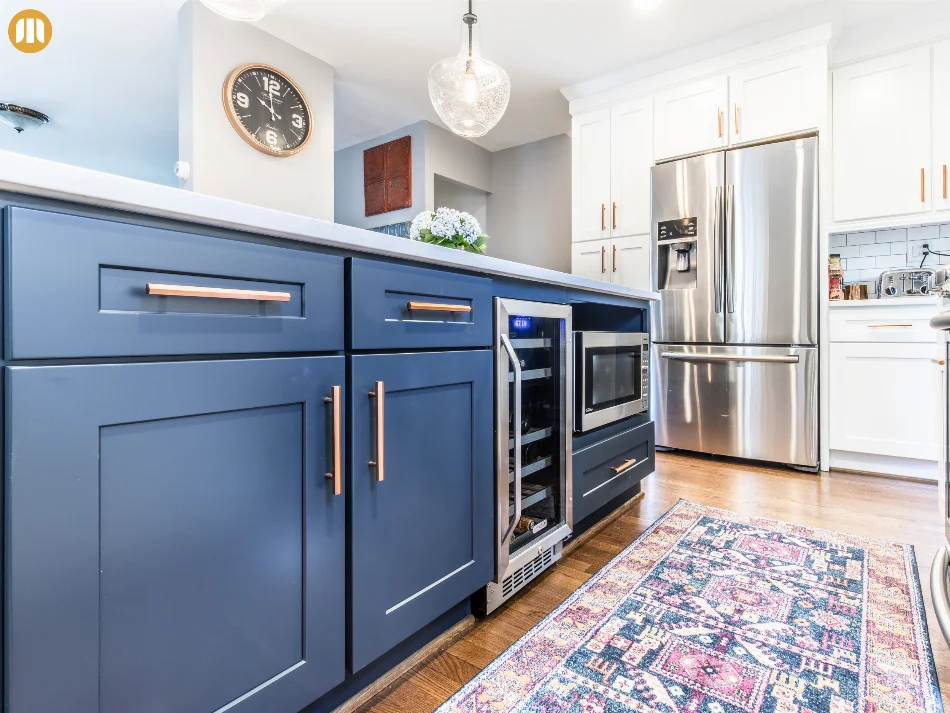
Read the cabinet as a set of components
Asking whether a cabinet is plywood or MDF is like asking what a car is made of. A cabinet has sides, a back, a bottom and shelves, plus doors and drawer fronts, drawer boxes and the hardware that holds it together. Manufacturers routinely mix materials: plywood boxes with MDF painted doors, particleboard boxes with solid-wood door frames, or a plywood sink base in an otherwise particleboard line.
So the useful question is what each component is made of, at what thickness and with what finish. A specification that lists those details for each part lets you compare two proposals fairly. A single word on a brochure does not.
What plywood, MDF and particleboard actually are
The U.S. Forest Service's Wood Handbook defines plywood as a flat panel built from sheets of veneer, with an odd number of layers and the grain of adjacent layers running at right angles. That cross-grain build gives plywood excellent dimensional stability. The handbook notes that plywood undergoes minimal irreversible thickness swelling if wetted, unlike most panels made from particles, and that its alternating grain resists splitting, so fasteners can be placed close to the edges. Its quality depends on the veneers, the layer order, the adhesive and the manufacturing control.
MDF, medium-density fiberboard, is made from wood broken down into fibers and pressed with adhesive. Particleboard is made from small wood particles pressed into a panel, typically in three layers with fine particles on the faces and coarser material in the core, which gives a smooth surface for laminating, overlaying, painting or veneering. The handbook explains that fiberboard uses the inherent strength of wood fibers to a greater extent than particleboard does.
Both MDF and particleboard for interior use are commonly bonded with urea-formaldehyde resins, which the handbook describes as interior adhesives because moisture exposure breaks down their bonds. That is the root of the familiar advice to keep these panels sealed and dry.
Source: USDA Forest Service: Wood Handbook (2021), Chapter 11, Wood-Based Composite Materials
| Property | Plywood | MDF | Particleboard |
|---|---|---|---|
| How it is made | Cross-laminated wood veneers | Wood fibers pressed with adhesive | Wood particles pressed with adhesive |
| Surface | Wood grain; may show voids at edges | Very smooth and uniform | Smooth faces, coarser core |
| Water exposure | Minimal irreversible swelling | Swells if water reaches unsealed edges | Swells if water reaches unsealed edges |
| Fasteners near edges | Strong; resists splitting | Less forgiving than plywood; use suitable fasteners | Less forgiving than plywood; joinery and glue matter |
| Common cabinet use | Boxes, sink bases, shelves | Painted doors, panels, drawer fronts | Economy boxes and shelves under laminate |
Match the material to the component
For cabinet boxes, plywood's screw holding and moisture behavior are real advantages, especially at the sink base and next to the dishwasher, where leaks happen. Good particleboard boxes with a durable laminate or melamine surface can perform well in dry locations at lower cost, provided the edges are sealed and the joinery is sound.
For painted doors, MDF is often the better choice. Its uniform surface does not show grain, and a five-piece door with an MDF center panel is less prone to the hairline cracks that can appear at the joints of painted solid-wood doors as the wood moves with the seasons. Stained doors are a different story, because stain needs real wood or a wood veneer. Shelves are worth checking separately, since a wide shelf can sag under heavy dishes if the material and thickness are not up to the span.
Plan for moisture where it actually happens
Water damages cabinets at a few predictable places: under the sink, beside the dishwasher, at the base of the refrigerator and along the toe kick where floors are mopped. Particleboard and MDF that get wet at an exposed edge can swell permanently. Plywood tolerates occasional wetting better, but no cabinet material is waterproof.
Moisture resistant is not the same as waterproof, so read the actual product's limitations. Ask how the sink base is protected, whether exposed edges are sealed, and whether a leak tray or water sensor is worth adding. Fixing a slow leak quickly matters more than any panel choice.
Look beyond the panel to joinery and hardware
A well-built particleboard cabinet can outlast a poorly assembled plywood one. Ask how the box is joined: glued and screwed, doweled, connected with cam fittings or held with staples. Look at the back panel's thickness and how it is attached, because the back keeps the box square. Check the drawer boxes, whether dovetailed solid wood, plywood or a metal system, and the drawer slides' type and weight rating. Hinges with adjustment and soft-close mechanisms affect daily use more than most panel choices.
Independent testing helps when it covers the exact product. The KCMA A161.1 Quality Certification tests a cabinet design's structure, drawers, doors and finish to simulate long-term use. Confirm that the specific line you are buying carries the certification, rather than assuming a whole brand or a contractor holds it.
Read emissions and certification claims carefully
Hardwood plywood, MDF and particleboard are the three composite wood products covered by the EPA's formaldehyde emission standards under TSCA Title VI, and the EPA notes that they are commonly used in kitchen cabinets. Finished goods made with these panels after March 22, 2019 must be labeled as TSCA Title VI compliant, with the fabricator's name and the month and year of production.
Compliance means the panels met the federal emission standard through certified testing. It is not a promise of zero emissions, and it is a different thing from a quality certification or a warranty. Ask to see the compliance label or documentation, the quality certification if one applies, and the written warranty, and keep all three with your project records.
Source: US EPA: Consumer questions on the Formaldehyde Standards for Composite Wood Products Act
Build an apples-to-apples cabinet schedule
When two quotes differ, lay their specifications side by side. Fill in the same fields for each and attach the manufacturer's documents. Gaps in the table are questions to ask before you sign.
| Component or question | Proposal A | Proposal B | Evidence to attach |
|---|---|---|---|
| Box sides and back | Material, grade, thickness | Same fields | Manufacturer specification sheet |
| Sink base | Material and edge protection | Same fields | Specification or option list |
| Doors and drawer fronts | Substrate, species or finish, construction | Same fields | Order specification and sample |
| Shelves | Material, thickness, support | Same fields | Load data if supplied |
| Drawer boxes and slides | Construction and slide rating | Same fields | Hardware data |
| Hinges | Type and adjustment | Same fields | Hardware data |
| Emissions compliance | TSCA Title VI label | Same fields | Label or documentation |
| Quality certification | Certified line, if any | Same fields | Certification listing |
| Warranty | Term and exclusions | Same fields | Written warranty |
Next step: Compare cabinet specifications for your project with Graves
Common questions
Is plywood better than MDF for kitchen cabinets?
For cabinet boxes, plywood usually holds screws better and tolerates occasional wetting better. For painted doors, MDF often performs better because it is smooth and stable. Compare the specified component, grade, finish and hardware rather than the material name alone.
Is particleboard bad for cabinets?
Not necessarily. Well-made particleboard boxes with sealed edges and sound joinery can work in dry locations. They are more vulnerable to permanent swelling if water reaches an exposed edge, so pay attention at the sink base.
Are MDF and particleboard the same thing?
No. MDF is made from wood fibers, while particleboard is made from small wood particles. Both need a product-specific specification.
Does moisture resistant mean waterproof?
No. Read the exact panel and finish limitations, and protect the sink base and dishwasher area against leaks.
Does a certification replace a warranty?
No. A certification describes a defined testing or compliance program; the warranty states the issuer's obligations and exclusions. Keep both documents.
Sources
Related reading
Published by Graves Design & Remodeling, Inc. · +17036604554
8346 Traford Ln Suite #7, Springfield, VA 22152