
Bathroom planning
Bathroom Remodel Waterproofing: Questions to Ask Before You Hire
Tile and grout are not waterproof, so a shower's real protection is a membrane or waterproof board hidden behind the tile. Before you hire, ask which waterproofing system will be used, how the floor slopes to the drain, how walls, corners and the drain are sealed, how long each product must cure and how the shower will be flood tested before tile goes on. A contractor who answers those questions clearly, in writing, is far more likely to build a shower that lasts. Vague answers are a warning sign.
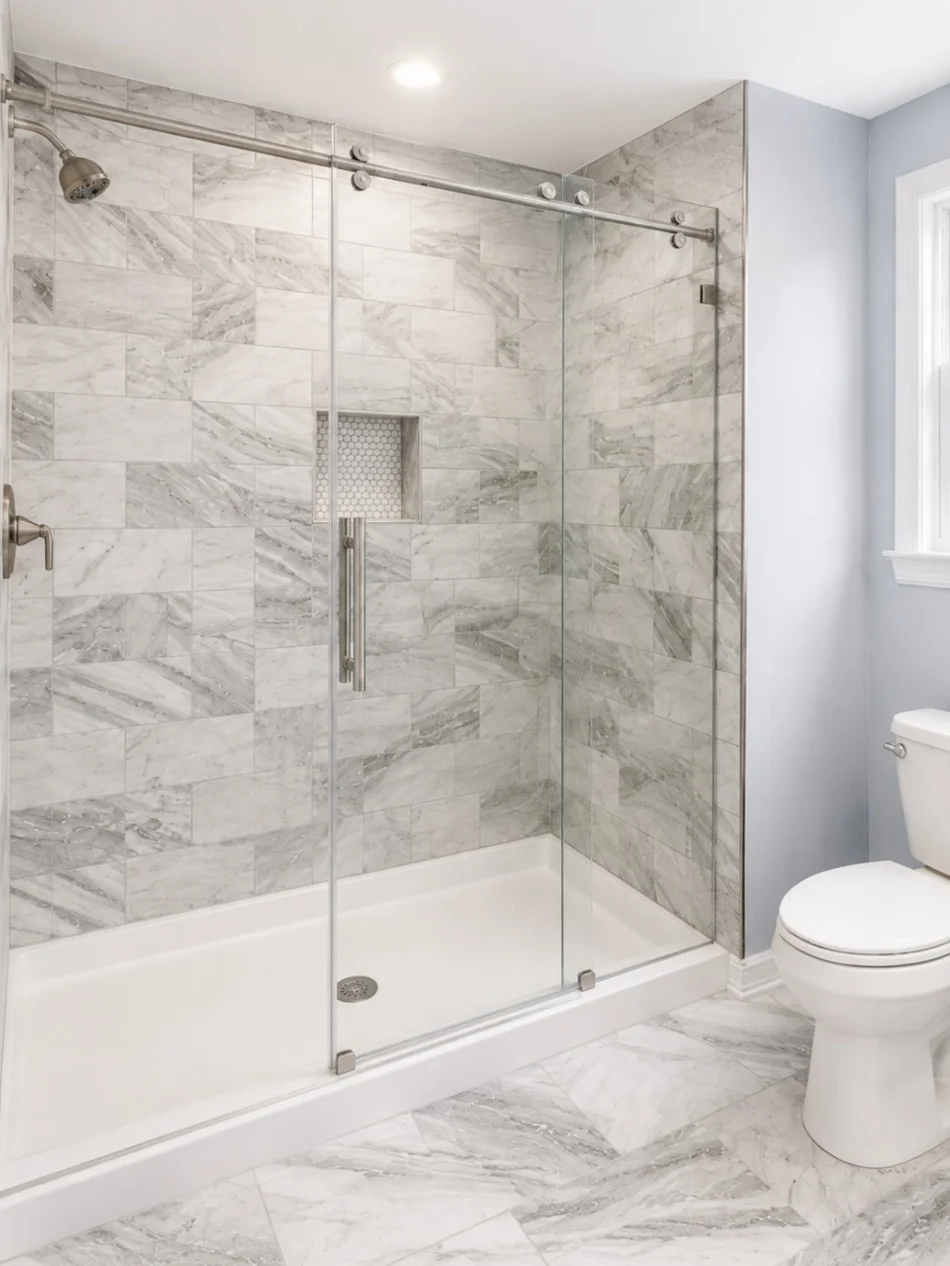
Why waterproofing matters more than the tile
The Ceramic Tile Education Foundation says plainly that there is a misconception that tile is waterproof. The tile surface, glazed or unglazed, may repel water, but other than porcelain, the body of the tile is absorptive to varying degrees, and the only way to stop water moving into the building structure is to provide a positive water barrier behind the tile. Grout is porous too, so water reaches the substrate through grout lines.
When that barrier fails, the damage is hidden. Water can soak wall framing, subfloors and the ceiling below, feed mold and rot wood for years before a stain shows. That is why the waterproofing is the part of a shower worth asking about most, and why a beautiful tile job over a poor membrane is a bad bargain.
Source: Ceramic Tile Education Foundation: Installing tile in wet areas (quoting the TCNA Handbook)
Question 1: Which waterproofing system will you use, and why?
Ask which complete water-management approach is proposed and why it suits the shower. Surface-applied membranes, suitable board systems and traditional receptor assemblies have different details. The important question is how the specified components form a coordinated assembly, including its transitions and terminations.
Have the installer identify the products, applicable standards and installation instructions for the selected method. Ask which areas receive waterproofing or a moisture-management layer and how the floor, walls, niche, bench and entry meet. Do not assume that one membrane detail applies to every lawful shower assembly.
Ask for a complete system, not parts from different makers. Membranes, drains, corners, seam tapes and mortars are designed to work together, and the manufacturer's warranty usually depends on using them as a system and following the installation instructions.
Source: Ceramic Tile Education Foundation: Installing tile in wet areas (quoting the TCNA Handbook)
Question 2: How will the floor slope to the drain?
Water that cannot reach the drain will sit on the surface and find its way into any defect. The foundation says that all surfaces in a wet area must slope toward the drain, including a niche, and that the plumbing code requires a shower floor to slope a minimum of 1/4 inch per foot to a maximum of 1/2 inch per foot. Ask how the slope will be built, and whether it is also built under the membrane, so that water which reaches the membrane is directed to the drain too, not only the water on the tile surface.
Ask about the curb and bench too: their tops should slope slightly toward the shower, and the niche shelf should slope out. A flat shelf holds standing water.
Source: Ceramic Tile Education Foundation: Installing tile in wet areas (quoting the TCNA Handbook)
Question 3: How are the walls, corners and drain sealed?
Ask the installer to explain each transition: wall to floor, corners, drain, valve, niche, bench and entry. The approved method may use particular corners, tapes, sealants or other components. Confirm the compatible parts and installation details for the chosen system rather than substituting a generic caulk detail.
Ask how far up the walls the waterproofing will go. In a shower, the whole enclosure should be protected, and the foundation notes that the shower walls and the shower floor fall into the most severe residential exposure class, described as tile surfaces that are soaked, saturated or regularly and frequently subjected to moisture. Also ask how the area outside the shower, such as the floor just beyond the door, will be protected from splashes.
Source: Ceramic Tile Education Foundation: Installing tile in wet areas (quoting the TCNA Handbook)
Question 4: How long will each product cure, and how will it be tested?
Thin-set mortar, liquid membranes and grout all need time to cure, and rushing causes failures. Ask for the cure times for the products you will use, and ask when the shower can be used. Manufacturers publish different times for different conditions.
Ask the installer to describe the specified water test, curing conditions and any inspection requirement before tile covers the assembly. Schluter distinguishes a test-plug check from the subsequent test of the shower assembly; the preliminary plug-check level is not the complete pan-test procedure. Have the responsible installer follow the selected manufacturer and local requirements, document the result and explain any retest after a repair.
Source: Schluter: What is a water test on the Schluter-Shower System?
Question 5: What is covered by the warranty, and who stands behind it?
Ask what the warranty covers: the membrane product, the installation, the whole shower. Ask for it in writing, and ask who honors it, the manufacturer or the contractor. Virginia DPOR advises homeowners to get all guarantees, warranties and promises in writing and to insist on a detailed contract.
Ask also about the contractor's own record. How many showers do they build a year? Have they had waterproofing failures? Can they show a recent shower, or speak to a client whose shower is a few years old? A confident, experienced contractor will welcome these questions.
Red flags and a quick comparison
Be cautious if a contractor says that waterproof grout or sealer alone is enough, that a flood test is unnecessary, that cement board is waterproof, or that a membrane is optional behind tile in a shower. Be cautious of any bid that does not name the system. Listen for specifics: product names, slope, test, cure times and warranty.
Use the table to compare what each bidder says, then follow up on any answer that matches a warning sign.
| Question | A good answer includes | A warning sign |
|---|---|---|
| System and standard | Named assembly, compatible components and applicable product standards | "We use a sealer" or no product named |
| Where it is applied | Floor, curb, walls, niche, bench and the splash zone outside | Floor only, or waterproofing stops at the curb |
| Slope | At least 1/4 inch per foot, under the membrane and in the tile | A flat mortar bed or slope only in the tile |
| Details | Preformed corners, sealed penetrations, a drain flange tied to the membrane | Caulk alone at corners and the valve |
| Cure and test | System-specific cure times, test procedure and documented result | "No need to test" |
| Warranty | Written, naming who honors it and what it covers | Verbal promise only |
- Name the waterproofing system and the standard it meets
- Confirm the slope under the membrane and in the tile
- Ask how corners, valve, niche and drain are sealed
- Get cure times and the flood test procedure in writing
- Ask to see the test water level at the start and end
- Get the warranty in writing
Ask for a waterproofing record, not only a finish sample
Before a Northern Virginia shower remodel, ask the proposal to identify the selected waterproofing system, compatible drain, treatment of penetrations and intended test. Have the installer explain when the work can be checked before tile covers it.
Request appropriate closeout information such as the installed product names, care instructions and written warranty responsibilities. Photographs of concealed work can be useful records, but they are not a substitute for required inspections or product instructions. An attractive finished shower alone does not verify what is behind the tile.
Common questions
Is tile waterproof?
No. The Ceramic Tile Education Foundation says the surface may repel water but, other than porcelain, the body of tile is absorptive, and grout is porous. A waterproof barrier behind the tile is what protects the structure.
How should a shower floor slope?
The plumbing code requires a slope of at least 1/4 inch per foot and no more than 1/2 inch per foot toward the drain, according to the Ceramic Tile Education Foundation.
What is a shower flood test?
A check before tile is installed: plug the drain, fill the shower base with water, mark the level and leave it for a specified time, with 24 hours typical for Schluter's system. If the level holds, the assembly passes.
What standard should a shower membrane meet?
The TCNA Handbook refers to ANSI A118.10 for waterproof membranes. Ask your contractor which standard the product meets and to confirm it in writing.
Does grout sealer make a shower waterproof?
No. A sealer can help the grout resist stains, but the waterproof layer behind the tile is what stops water reaching the structure.
Sources
Related reading
Published by Graves Design & Remodeling, Inc. · +17036604554
8346 Traford Ln Suite #7, Springfield, VA 22152