
Bathroom planning
Bathroom Ventilation During a Remodel
A bathroom fan has to do three things: move enough air, move it directly outdoors and run when you need it. The EPA says it is not enough that the motor makes noise or that the fan is running, and that the air must be exhausted to the outside, not into an attic or another space in the house. A remodel is the best moment to fix an old or undersized fan, because walls and ceilings are open and ducts can be rerouted. Ask for the fan's certified rating, a duct route that vents outdoors and a control that suits how your household uses the room.
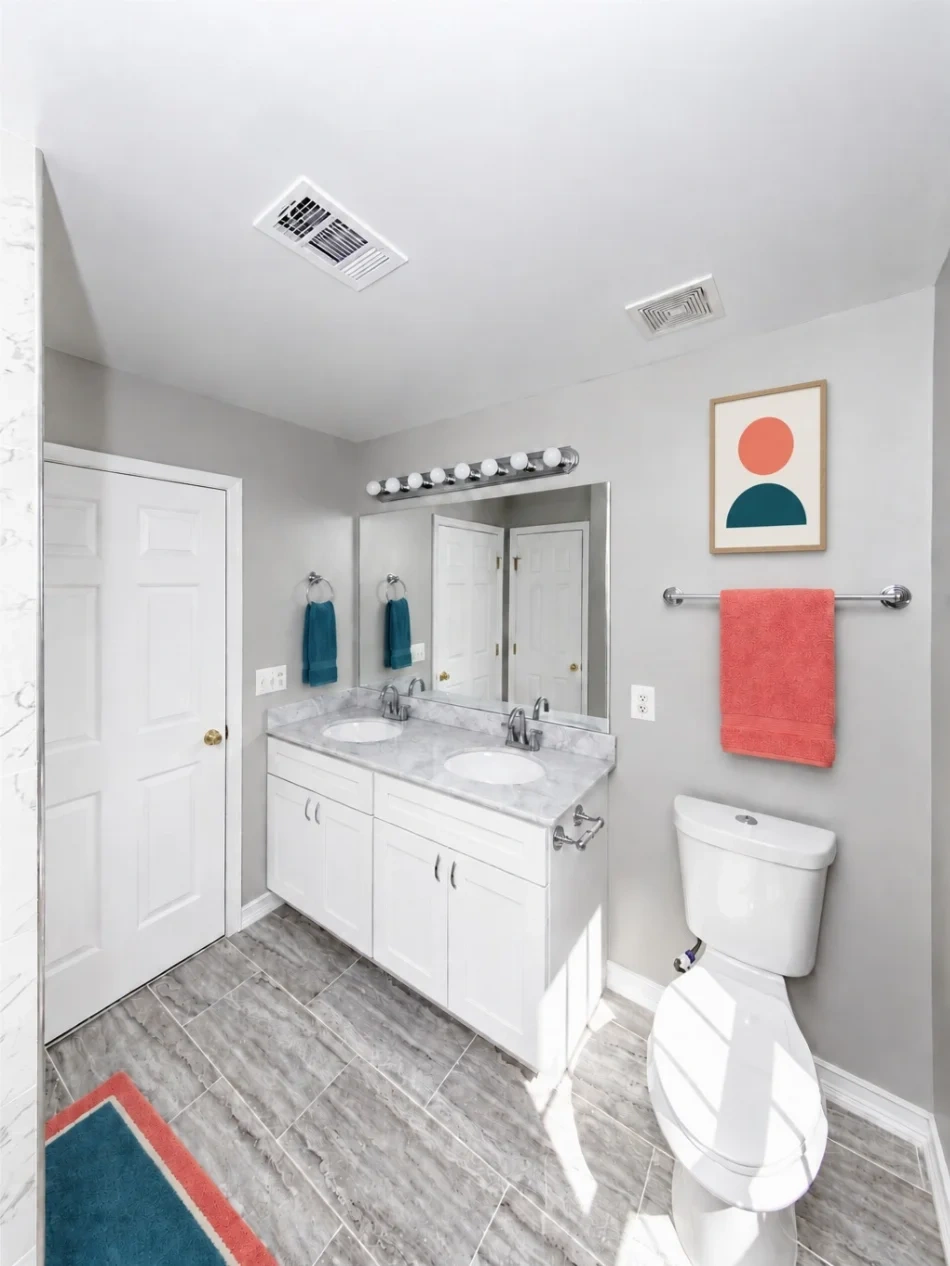
Why ventilation is part of the waterproofing plan
A shower puts a lot of moisture into the air, and if that moisture does not leave, it condenses on cold surfaces, soaks into paint and drywall and feeds mold. The EPA says that good ventilation protects both your health and your home, that it is especially important in bathrooms to remove unwanted moisture, and that this helps prevent the growth of mold and mildew, which can cause allergic reactions and aggravate lung diseases such as asthma.
That is why ventilation belongs in a bathroom remodel plan alongside waterproofing and tile. A beautiful shower built in a room with a weak fan will show peeling paint, damp ceilings and musty odor within a few years, and the cost of fixing it later is far greater than getting it right while the room is open.
How much air the fan should move
Size the fan for the room and its moisture-producing fixtures, then account for the actual duct system. HVI publishes residential sizing guidance, while the local code and project conditions determine the applicable requirements. A product's rated airflow is not proof of the airflow delivered by a particular installed duct.
The Home Ventilating Institute certifies home ventilating products so that buyers can compare ratings fairly, and its certified ratings include airflow in cfm and sound in sones. Ask for a fan with an HVI-certified rating, and ask your contractor how the fan was sized for your room. A bigger fan is not always better: an oversized fan with a long, narrow duct may move less air than a smaller one with a short, straight run.
The duct route: out, not up
The most common failure in an existing bathroom is a fan that exhausts into the attic. The EPA says the air should be exhausted directly to the outside and not just into an attic or some other space in the house, and that if you do not have a bathroom exhaust fan, or your current fan is not working, you should install one. Moisture dumped into an attic condenses on the roof framing and insulation and can lead to mold and rot.
A good duct is short, straight and smooth, with as few bends as possible, insulated where it passes through unconditioned space so condensation does not run back toward the fan, and terminated at an exterior wall or roof cap with a damper. Long runs and sharp bends reduce airflow, and flexible duct that sags collects water. Ask where the duct will go, how long it is and what it connects to on the outside.
Noise, controls and the fan people actually use
A fan that is too loud is a fan nobody turns on. HVI's ratings include a sound level in sones, where a lower number is quieter, so compare it as well as the airflow. A quiet fan is likelier to be used, which matters more for moisture control than a high rating on a fan that stays off.
Choose a control that fits how you live. A humidity-sensing control starts the fan when moisture rises, a timer lets the fan run for a set time after you leave and a switch that is separate from the light makes it easy to run the fan longer than the light. The EPA notes that, in cold climates, bathroom fans can be used as part of a whole-house ventilation strategy, and that ENERGY STAR has finalized a ventilation fan specification, which gives you another way to compare products.
Source: US EPA: Remodeling your home and indoor air quality
Source: Home Ventilating Institute (HVI): Certified ratings programs
Combustion appliances and make-up air
Exhaust fans pull air out of the house, and that air has to come from somewhere. The EPA cautions that if a home exhausts a lot of air, it can become depressurized, and enough depressurization can pull air and combustion products back down a chimney or flue, such as that of a gas water heater, into the house, bringing harmful substances such as carbon monoxide. A remodel that adds fans, a range hood and tighter construction can contribute to it.
If your house has gas or oil appliances, ask your contractor or an HVAC professional about combustion safety whenever a project adds exhaust or tightens the house. Check that carbon monoxide alarms are present and working.
Source: US EPA: Best practices for indoor air quality when remodeling your home
Basement bathrooms and code requirements
Basement bathrooms have no window to open in many cases, so the fan is essential. Fairfax County's Typical Finished Basement Details require that bathrooms be equipped with a fan vented directly to the outside, and say that a fan is not required if the bathroom has a window with an opening of 1.5 square feet or more. Even with a window, a fan is a good idea, because you cannot count on an open window in cold or wet weather.
Because a basement ceiling is often low and filled with joists, ducts and pipes, the route for the exhaust duct is a design problem to solve early. Ask how the duct will reach an exterior wall and what will conceal it.
Air sealing and moisture in the walls and ceiling
The EPA points out that, despite good ventilation, moist air from a bathroom can still make its way into wall and ceiling cavities, and that a remodel is an opportunity to improve air sealing: electrical, plumbing and ventilation penetrations should be sealed where they are accessible or in any walls that are opened. Ceiling light fixtures, the fan housing and the duct connection are common leakage points into the attic.
Ask your contractor whether the ceiling is being opened, and if so, whether the fan housing and fixtures will be sealed to the drywall and the duct connection taped. These small steps keep warm, moist air out of cold spaces.
Questions to ask before the fan is chosen
These questions turn ventilation from an afterthought into a specified part of the project.
- What is the fan's HVI-certified airflow and sound rating?
- How was the fan sized for this room and the shower?
- Where does the duct go, how long is it and where does it end outside?
- Is the duct insulated and sealed where it passes through cold space?
- Does the control suit the household: humidity sensor, timer or switch?
- Will the fan housing be sealed to the ceiling?
- Are there gas or oil appliances that need a combustion-safety check?
Related: Bathroom waterproofing: questions to ask before hiring
Next step: Plan your bathroom ventilation with Graves
Follow the complete exhaust route in your home
When planning a bathroom remodel in Springfield or Lorton, ask where the existing fan actually discharges. A grille in the ceiling is not evidence of a continuous duct to an outdoor termination. Have the route and available access checked before choosing a replacement fan.
Coordinate the duct, exterior termination, insulation where appropriate and controls with the rest of the remodel. Ask which permits or inspections apply to any changed wiring or mechanical work. A quieter fan that the household uses consistently is useful only when the installed system can move the intended air.
Common questions
How many CFM does a bathroom fan need?
The EPA cites ASHRAE recommendations of 25 cfm for a continuously running fan or 50 cfm for one that is switched on and off. A larger bathroom or heavy shower use may need more.
Can a bathroom fan vent into the attic?
No. The EPA says the air should be exhausted directly to the outside, not into an attic or another space in the house.
Is a noisy fan an effective fan?
Not necessarily. The EPA says it is not enough that the motor makes noise or the fan is running; it has to exhaust a sufficient amount of air.
Does a basement bathroom need a fan?
Fairfax County's typical basement details require a fan vented directly outside unless the bathroom has a window with an opening of at least 1.5 square feet.
What does HVI certification mean?
The Home Ventilating Institute certifies home ventilating products so that buyers can compare airflow in cfm and sound in sones on a consistent basis.
Sources
- US EPA: Remodeling your home and indoor air quality
- Home Ventilating Institute (HVI): Certified ratings programs
- US EPA: Best practices for indoor air quality when remodeling your home
- Fairfax County: Typical Finished Basement Details (2021 Virginia Residential Code, version July 14, 2024)
- HVI: Bathroom exhaust fan consumer guide
Related reading
Published by Graves Design & Remodeling, Inc. · +17036604554
8346 Traford Ln Suite #7, Springfield, VA 22152