
Bathroom planning
Bathroom Tile and Grout Selection: What to Check
Choose bathroom tile and grout by application: a shower floor, main floor and wall can need different products. Confirm the manufacturer's intended use, drainage compatibility, maintenance and installation requirements before ordering. Tile and grout do not replace the specified waterproofing system. A slip-test number alone is not a shower-floor approval.
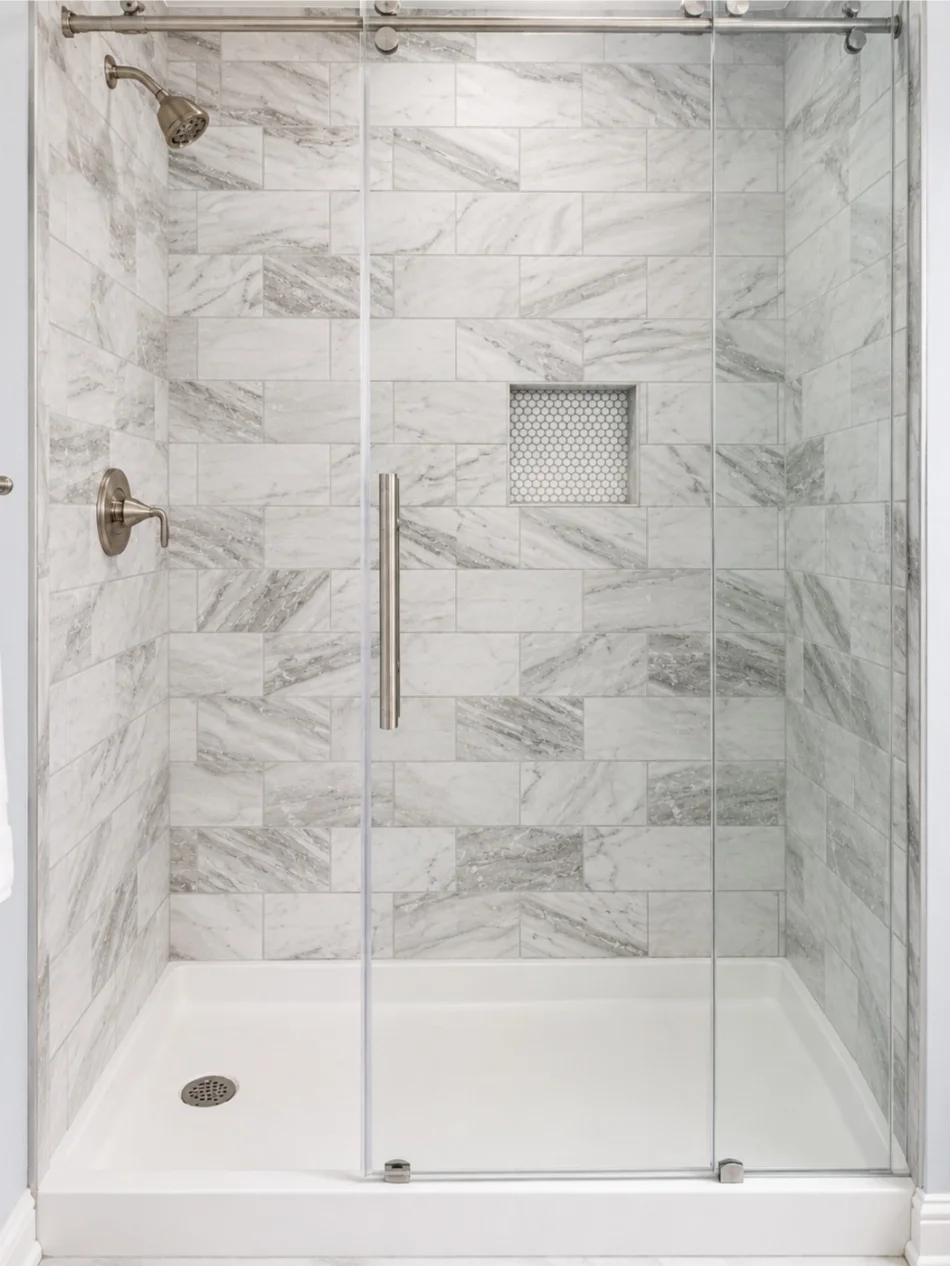
Match the tile to the place: floor, shower floor, walls
Bathroom tile does three different jobs. Bathroom floors need grip when wet and durability under foot traffic. Shower floors need grip, a pattern that follows a slope and a grout layout that drains. Walls need to resist moisture and be easy to clean, but they do not need to carry load or provide traction, so a smoother, glossier tile can work well on a wall.
Choosing one tile for everything can cost you. A large, polished tile that looks good on the wall may be a hazard on a wet floor, and a textured floor tile can trap soap scum on a wall. Many designs use a coordinating pair: a smooth wall tile and a textured or mosaic floor tile in a matching color.
Slip resistance: what DCOF means and what it does not
DCOF is a test measurement used when assessing slip resistance. TCNA explains the test and product-use guidance, but a number by itself does not establish that a tile is suitable for every bathroom application. Ask for the exact product and finish data, including the manufacturer's intended-use classification.
Shower-floor selection needs particular care. ANSI A326.3 does not give one DCOF limit for all shower floors: drainage, texture, joints and barefoot use affect suitability. Obtain explicit confirmation for the intended application rather than using a level-floor threshold as a shower approval.
Discuss cleaning, expected users and any mobility needs with the designer. Neither extra grout lines nor a rough-feeling sample guarantees safety. Review how the complete floor will drain and be maintained.
Source: TCNA: Dynamic coefficient of friction and application guidance
Size, grout lines and the shower floor slope
Shower floors slope toward the drain, and tile has to follow that slope. The Ceramic Tile Education Foundation notes that all surfaces in a shower must slope toward the drain, including a niche, and that the plumbing code requires a shower floor to slope at least 1/4 inch per foot and at most 1/2 inch per foot. A large flat tile does not bend, so on a sloped floor it must be cut into pieces or set in a single-slope design. Small tiles, such as mosaics of 2 inches or less, follow the slope easily and create more grout joints.
On walls, large tiles need a suitably prepared, flat substrate; smaller tiles do not excuse an uneven or unsuitable base. Ask the installer to draw the layout and resolve cuts, edges, niches and movement joints before ordering. Product and installation requirements should determine preparation and joint treatment.
Source: Ceramic Tile Education Foundation: Installing tile in wet areas (quoting the TCNA Handbook)
Porcelain, ceramic and natural stone
Tile is not all the same. The Ceramic Tile Education Foundation says the surface of tile, glazed or unglazed, may repel water, but other than porcelain, the body of the tile is absorptive to varying degrees. Porcelain tile is dense and absorbs very little water, which is why it is a popular choice for showers and floors. Ceramic tile is often lighter, easier to cut and well suited to walls. Natural stone is beautiful but varies from piece to piece and may need sealing and gentler cleaners, so ask for the stone supplier's care instructions.
Whatever you choose, ask the supplier for the technical data sheet: water absorption, DCOF, recommended use and care. A tile that is great for a wall can be wrong for a shower floor, and the data sheet will tell you.
Source: Ceramic Tile Education Foundation: Installing tile in wet areas (quoting the TCNA Handbook)
Grout: joint width, material and maintenance
Grout fills the joints, and it is the most maintenance-intensive part of a tiled bathroom. Narrow joints look sleek but are less forgiving of tile size variation, wider joints allow for imperfect tile edges and more traction. Grout color affects how visible dirt and mildew are: very light grout shows stains and very dark grout shows soap film and efflorescence.
Grout comes in several types, including cement-based and epoxy-based, and they differ in stain resistance, maintenance and working time during installation. Ask your installer what grout will be used, how it is cured and whether it needs sealing, and for care instructions from the manufacturer. Remember that grout is porous in many forms, and that even excellent grout does not make a shower waterproof.
Tile does not make a shower waterproof
The Ceramic Tile Education Foundation says there is a misconception that tile is waterproof, and that the only way to stop the movement of water into a building's structure is a positive water barrier behind the tile. In a shower, the floor and the walls fall into what the TCNA Handbook calls the residential wet exposure class, meaning tile surfaces that are soaked, saturated or regularly and frequently subjected to moisture.
That is why tile selection is only half the job. Ask your contractor how the walls and floor will be waterproofed, what product is used and how it will be tested before tile goes on.
Source: Ceramic Tile Education Foundation: Installing tile in wet areas (quoting the TCNA Handbook)
More on waterproofing: Bathroom waterproofing: questions to ask before hiring
Samples, quantities and ordering
Never choose tile from a photograph. Get a full-size sample, and look at it in your bathroom's light, wet and dry, next to your vanity top, paint and fixtures. Handle it: feel how slippery it is when wet, and check edges for chipping. Ask whether the product has lot-to-lot color variation, and order all you need from the same production lot, with extra for cuts, waste and future repairs, since discontinued tile is hard to match.
Before ordering, confirm the quantity with your installer, who knows the layout and where the cuts fall. Confirm delivery dates, because special-order tile can take weeks and a missing box can stop a project.
A short tile and grout checklist
Use this list to compare options and to prepare for the showroom or the supplier.
| Location | What matters most | Typical choice | Check |
|---|---|---|---|
| Bathroom floor | Grip when wet; durability | Porcelain with a textured finish | Manufacturer-confirmed suitability for the intended wet-floor application |
| Shower floor | Grip; follows the slope | Small mosaic or single-slope design | DCOF; layout around the drain |
| Shower walls | Moisture resistance; easy cleaning | Porcelain or ceramic, smooth or glazed | Water absorption; membrane behind |
| Niche and bench | Slope to shed water; durable top | Same wall tile, sloped | Slope built in |
| Accent areas | Appearance | Stone, glass or decorative tile | Care needs and suitability for wet use |
- Ask for the DCOF rating on floor and shower floor tile
- Feel a wet sample and choose smaller tile for the shower floor
- Confirm the tile suits its location on the technical data sheet
- Ask what grout will be used, its color and its care
- Confirm the waterproofing system behind the tile
- Order from one lot, with extra for cuts and future repair
Next step: Talk with Graves about tile and your bathroom plan
Make a tile selection sheet before ordering
For a Fairfax-area bathroom, put each product on a separate line: main floor, shower floor, shower wall, niche and trim. Record the exact collection, finish, size, intended-use approval, grout and care requirements. One product name can include finishes with different suitable applications.
Ask the supplier and installer to resolve the layout, substrate preparation, slopes and movement joints before the order. Keep a record of the supplied lot information and agreed spare material. A sample board helps compare appearance, but it cannot establish that a finished installation will never be slippery.
Common questions
What is a good DCOF rating for bathroom tile?
Ask for the test data and intended-use classification for the exact finish. Shower-floor suitability needs a separate application assessment; a level-floor DCOF threshold is not a universal shower-floor approval.
What tile is best for a shower floor?
Small tiles or mosaics with a suitable slip rating follow the slope to the drain and add grout lines for traction. Porcelain is a common choice because it absorbs very little water.
Is porcelain better than ceramic for a shower?
Porcelain is denser and absorbs less water, so it suits shower floors and walls well. Ceramic is often easier to cut and is fine on walls. Check each product's data sheet.
Is tile waterproof?
No. The Ceramic Tile Education Foundation says tile surfaces may repel water but, other than porcelain, the body is absorptive, and grout is porous. A water barrier behind the tile is needed.
How much extra tile should I order?
Ask your installer, who knows the layout and the cuts. Plan for waste and for spare tile for future repairs, and order from the same lot.
Sources
Related reading
Published by Graves Design & Remodeling, Inc. · +17036604554
8346 Traford Ln Suite #7, Springfield, VA 22152